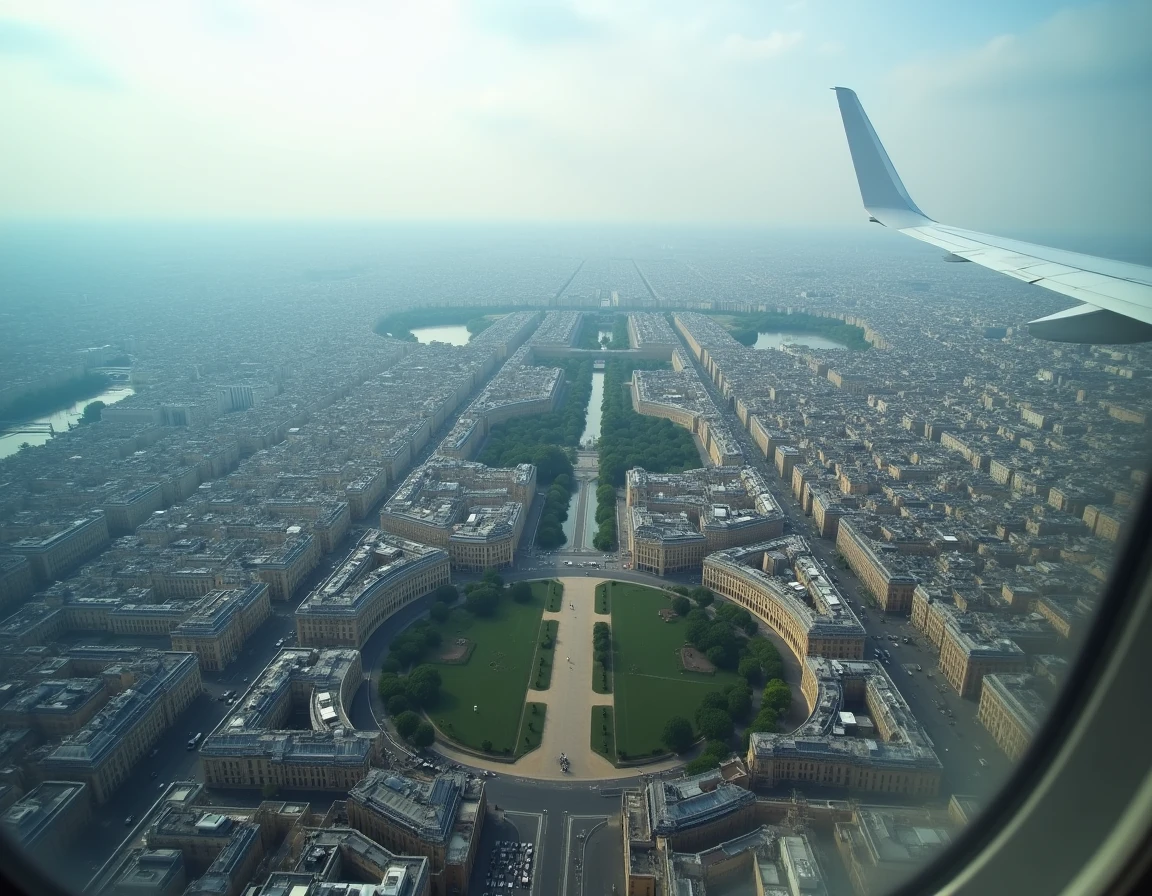
Paris intra-muros covers 105.4 km². This figure, often cited without context, says almost nothing unless we specify what it is being compared to, and especially how it is compared. The Paris municipal perimeter has no direct equivalent in most major global metropolises, which makes any raw juxtaposition of areas misleading.
Perimeter Bias: Why Comparing Paris to London or New York Doesn’t Work

The municipality of Paris corresponds to an administrative division inherited from the 19th century, fixed to the limits of the périphérique ring road. This perimeter only covers a fraction of the actual urban area. When we read that a city like London or New York is “ten times larger than Paris,” we are actually comparing a French municipality to metropolitan entities integrated under a completely different institutional model.
Greater London, for example, encompasses 32 boroughs and the City under a single authority. This is not a municipality in the French sense, but a metropolitan level. New York City federates five boroughs (Manhattan, Brooklyn, Queens, the Bronx, Staten Island), each the size of a large European city. Berlin, on the other hand, is both a Land and a municipality, which gives it a municipal area unrelated to the Parisian scale.
Comparing the area of Paris in km² to these entities amounts to measuring a district against a region. The bias is not trivial: it distorts the perception of density, produced wealth, and capacity.
Municipal Area and Population Density: The Parisian Case Against Tokyo and Madrid

Paris concentrates about 2.1 million inhabitants on its 105.4 km², making it one of the most densely populated central cities in the world. This density is explained by Haussmannian architecture: adjoining buildings of six to seven stories, small inner courtyards, small apartments, narrow streets. The almost total absence of breaks in the urban fabric over several kilometers creates a built continuum unmatched in North American or Asian metropolises.
Tokyo illustrates the other extreme. The Tokyo prefecture far exceeds 2,000 km² and even includes rural and island areas. Comparing the density of “Tokyo” to that of “Paris” without harmonizing the perimeters produces an absurd result. The central wards of Tokyo (the 23 special wards) offer a more relevant point of comparison, but their combined area remains several times larger than that of intra-muros Paris.
Madrid presents an intermediate case. The municipality of Madrid is much larger than Paris, which mechanically dilutes its average density. However, the central neighborhoods (Centro, Salamanca, Chamberí) display densities comparable to certain Parisian districts.
What Parisian Density Implies for Urban Planning
The Parisian model was designed to maximize land use. Investors from the Second Empire sought maximum rental yield while adhering to imposed building standards. This historical choice has produced a city where the share of green spaces per inhabitant remains among the lowest of European capitals.
Metropolises with larger municipal areas (Berlin, Rome, London) have integrated parks, forests, wastelands, and suburban areas into their perimeter. This profoundly changes the quality of life indicators used in international rankings.
Grand Paris and International Comparison Scenarios
The Paris metropolitan area gathers about 13.2 million inhabitants. Reasoning at this scale radically alters Paris’s position in global comparisons. We are no longer talking about a small dense municipality, but an urban basin that competes with the largest agglomerations on the planet.
The Grand Paris Metropolis project, created in 2016, covers 131 municipalities. Its area far exceeds that of intra-muros Paris, but remains modest compared to structures like Greater London. Recent discussions on a potential “City of Grand Paris” evoke scenarios where the Parisian institutional perimeter would expand sufficiently to make international comparisons finally coherent.
What Perimeter to Compare What
We recommend always specifying three levels when comparing Paris to other metropolises:
- The strict municipality (105.4 km²), relevant only for measuring the density of the historical center against other city centers (Manhattan, the 23 wards of Tokyo, London Zone 1).
- The Grand Paris Metropolis or urban unit, suitable for comparisons with Greater London, New York City, or the Tokyo prefecture on issues of transport, housing, and employment.
- The area of attraction, which encompasses the suburban crown and allows for comparisons between Paris and North American or Asian metropolitan areas, often measured at this scale.
Mixing these levels in the same table amounts to comparing incompatible geographical objects. The choice of perimeter determines the result, not the underlying urban reality.
Area of Paris and Real Estate Prices: A Mechanical Link
The small size of the Parisian municipal perimeter has a direct consequence on the housing market. With almost no land available for construction, the pressure on prices is structural. Metropolises with larger municipal areas maintain internal land reserves that partially cushion price increases.
Berlin, despite sustained demographic growth in recent years, has long maintained square meter prices significantly lower than those in Paris. The municipal area of Berlin, which includes still underdeveloped areas, offers a planning lever that Paris has not had for decades.
The narrowness of the Parisian perimeter partly explains the real estate boom observed since the 2000s. Housing policies, rent control measures, and Grand Paris Express projects cannot be understood without this fundamental geographical parameter.
Any comparison of real estate prices between Paris and another major metropolis should integrate the municipal area as an explanatory variable, rather than as a mere descriptive data point. Otherwise, one attributes to “demand” or “speculation” a phenomenon that primarily relates to administrative geography.