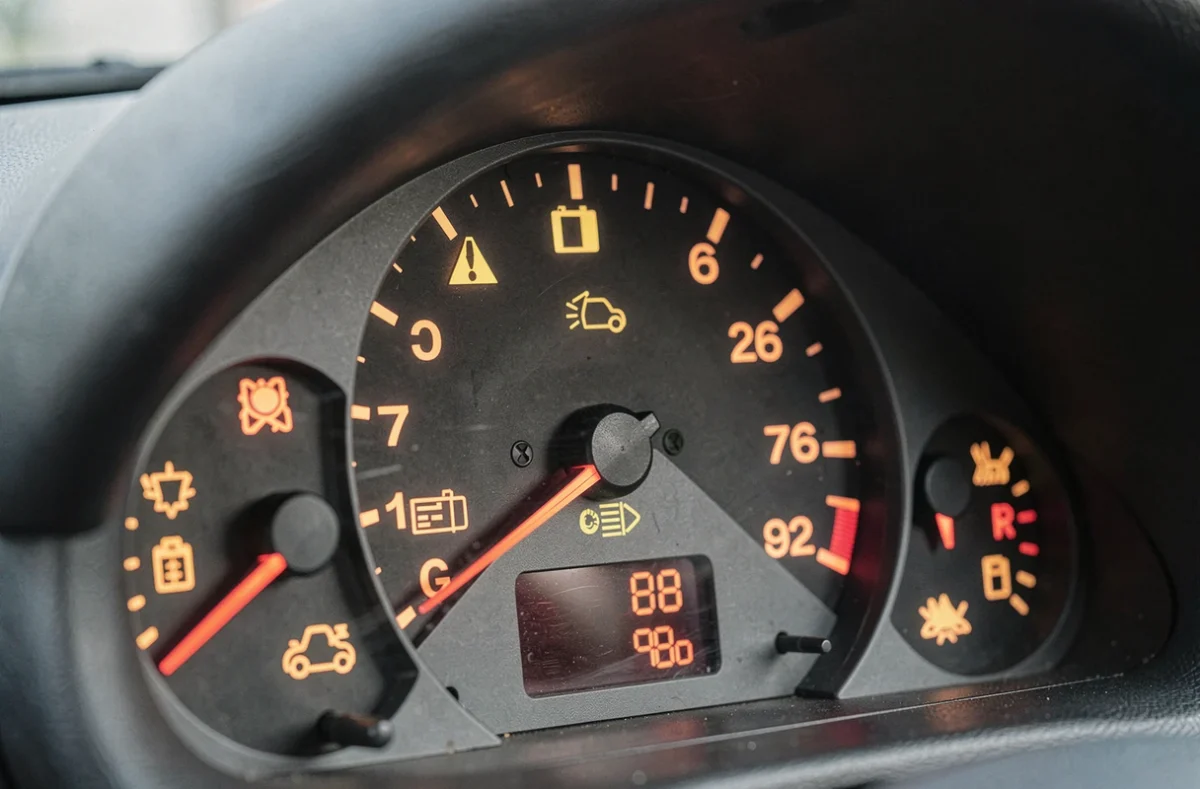
The Peugeot 206, produced for over a decade, features a dashboard where the warning lights convey very different types of information. Some indicate normal operation, while others require an immediate stop of the vehicle. The issue is that the icon alone is not always sufficient for a reliable diagnosis, and a light that is off does not guarantee the absence of an anomaly.
Warning light on at the start of the 206: normal or not
All dashboard lights briefly illuminate when the ignition key is turned. This sequence of a few seconds allows for checking that each warning light is functioning. If a light does not come on during this phase, the problem may be due to a burnt-out bulb, a faulty relay, or a blown fuse.
This is a point often overlooked: a faulty light will no longer signal a real failure. A driver who never sees their oil pressure light come on at startup should be just as concerned as if they saw it stay on while driving.
After the engine starts, most warning lights should turn off within a few seconds. Any light that persists beyond this initial phase indicates an anomaly to investigate, the severity of which depends on its color and icon. To understand the list of dashboard warning lights for the Peugeot 206, one must first master the color code used by the manufacturer.
Color code of Peugeot 206 warning lights: three levels of severity
The signaling system is based on three main colors, each corresponding to a distinct level of urgency.
- Red lights require a quick stop of the vehicle. They relate to engine oil pressure, coolant temperature, brake fluid level, the handbrake being engaged, or battery charge. Continuing to drive with a red light on exposes the engine to damage or brake failure.
- Orange lights indicate a malfunction that requires prompt attention without necessitating an immediate stop. This includes the engine warning light (injection), ABS alert, or the particulate filter light on diesel versions. Ignoring an orange light for several days can lead to gradual degradation of the affected system.
- Green and blue lights are signaling indicators: low beams, turn signals, high beams. They confirm that a piece of equipment is active and do not require any specific intervention.
Airbag light on the 206: why the diagnosis is more complex than it seems
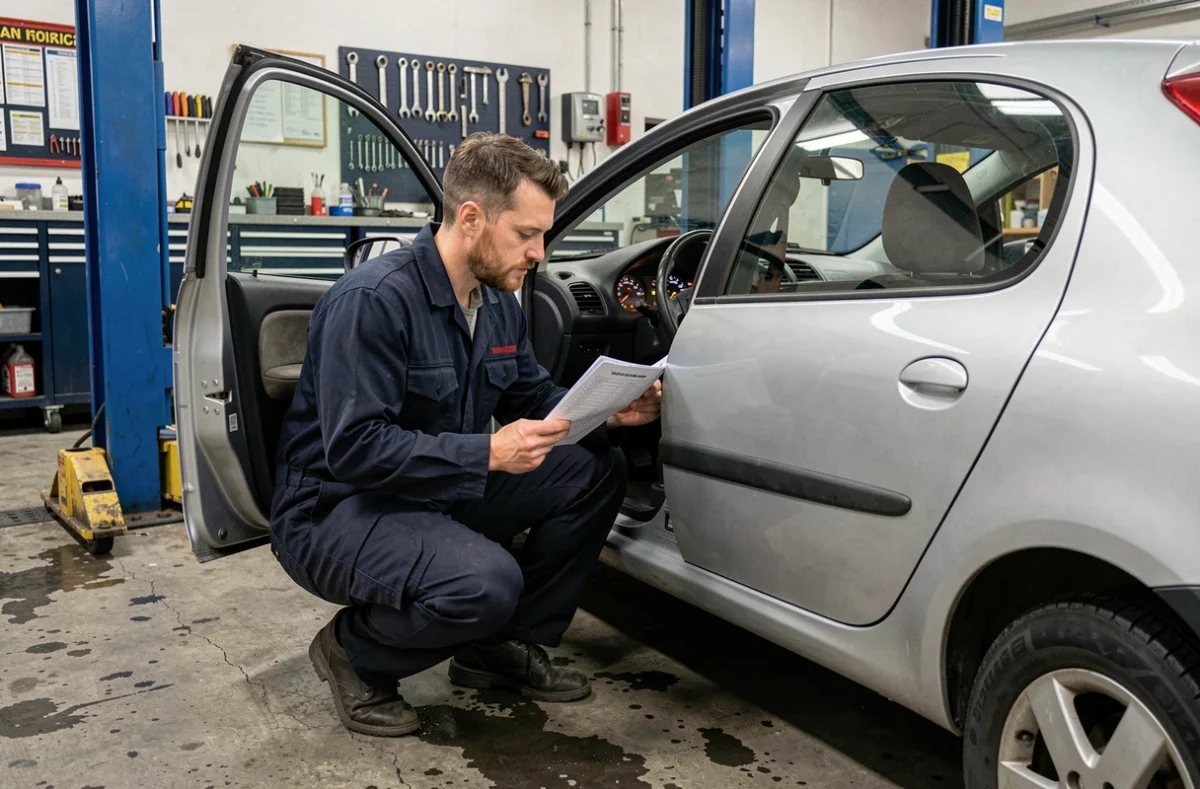
The airbag light is one of the most misinterpreted indicators on the Peugeot 206. Its constant illumination after the startup phase indicates a fault in the restraint system, but the icon does not allow for identifying the faulty part.
On this car, the restraint system is not limited to airbags. It includes seatbelt pretensioners, the rotary switch located in the steering column, and electrical connectors under the seats. A poor connection on any of these elements is enough to trigger the light.
Another limitation to be aware of: a generic OBD reader may not read the airbag ECU. The SRS system uses a dedicated ECU, and some consumer diagnostic tools simply do not access it. The absence of a fault code on a basic reader does not prove that the system is functioning correctly. A reliable diagnosis requires a tool compatible with the SRS ECU protocol of Peugeot.
A safety point not to be confused with diagnosing warning lights: vehicles subject to a manufacturer recall (notably regarding Takata airbags) do not necessarily show an illuminated warning light. A normal dashboard does not mean that no recall is in progress. Verification is done by the VIN number with the manufacturer, not through the dashboard.
Engine light and STOP light on the 206: two different logics
The engine light (orange, in the shape of a stylized engine block) comes on when the injection ECU detects an anomaly in engine management. Possible causes range from a simple faulty sensor to an ignition problem or air-fuel mixture issue. This light triggers a limp mode on certain versions, limiting available power.
The STOP light, on the other hand, operates according to a different logic. It is a centralized alert light that illuminates in conjunction with another red light to signal an emergency. Insufficient oil pressure, excessively high engine temperature, low brake fluid level: the STOP confirms that the situation requires stopping the vehicle as soon as possible.
The common confusion is treating the orange engine light with the same urgency as the red STOP light, or conversely neglecting a STOP because it accompanies a light deemed benign. The rule for the 206 remains simple: any red light associated with the STOP requires shutting off the engine as soon as possible and not resuming driving without verification.

Light that turns off after restarting: false good news
A common reflex is to restart the vehicle when a light comes on, then consider the problem solved if the light disappears. This logic is misleading. A light that turns off after restarting does not guarantee that the anomaly has disappeared.
Some faults are intermittent by nature. A sensor that loses signal when hot may function normally when cold. An oxidized connector may restore contact after a vibration. The ECU sometimes records the fault in memory without turning the light back on in the next cycle.
On the 206, this situation particularly concerns the airbag light and the engine light. In both cases, running a diagnostic allows reading the stored fault codes, even if no light is illuminated at the time of consultation. Ignoring an intermittent light is like betting that the problem will not recur when the system is called upon, which, for an airbag or braking circuit, is not a reasonable bet.
The Peugeot 206 remains a vehicle whose onboard electronics, although less sophisticated than those of recent models, rely on sensors and ECUs that age. Poor contacts, oxidation of connectors, and wear of wiring become more frequent as the vehicle ages. Every light that comes on, even briefly, deserves to be recorded and checked during the next intervention.