
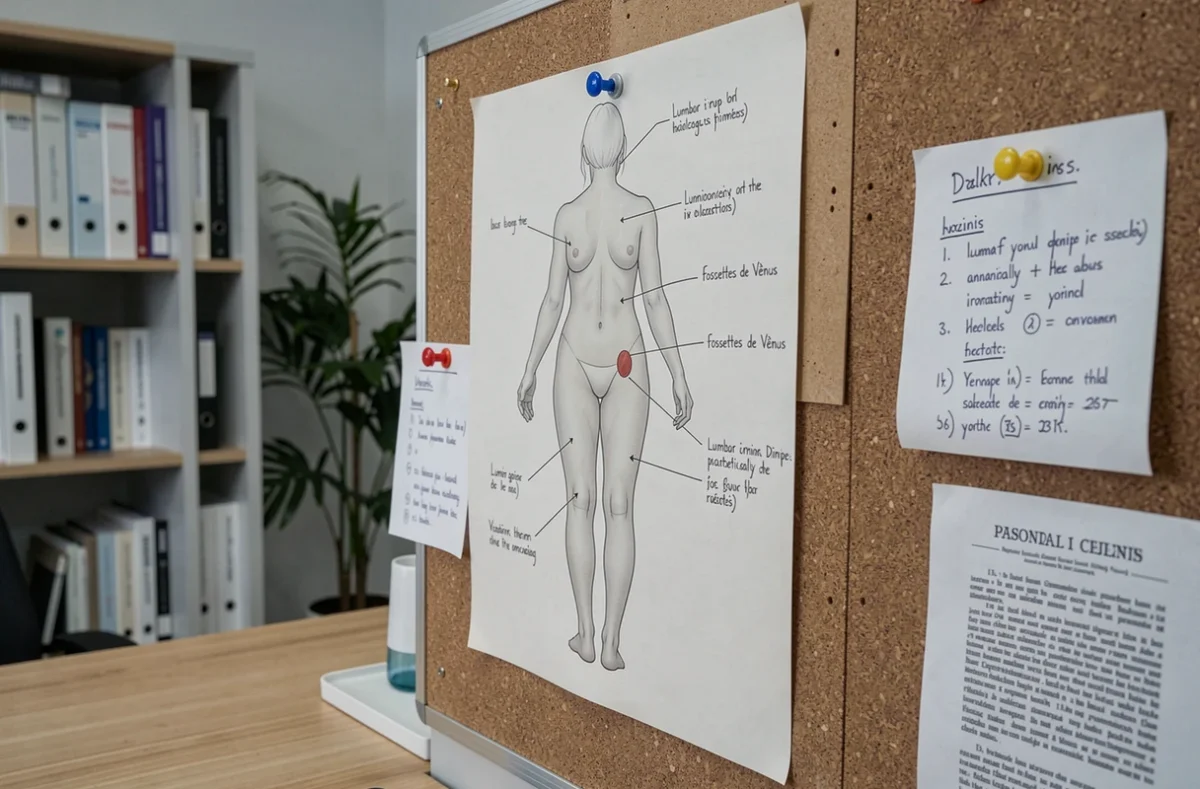
Venus dimples are two small indentations visible in the lower back, on either side of the sacrum. Their name evokes sensuality, but their origin is strictly anatomical: they correspond to the area where the skin covers the posterior superior iliac spines. Understanding what causes them, what they really indicate, and how effective the techniques claimed to create them are helps separate fact from appealing interpretations.
Venus dimples and sacral dimples: two distinct structures
A common misconception is to group indentations that differ in both location and clinical significance under the same term. Distinguishing between them early on can prevent unnecessary concern, particularly in infants.
| Criterion | Venus dimples (sacroiliac dimples) | Sacral dimple |
|---|---|---|
| Number | Two, bilateral | One, midline |
| Location | Lateral to the sacrum, above the intergluteal cleft | Low down, on the midline of the sacrum |
| Origin | Bony prominence of the posterior superior iliac spines | Skin indentation, sometimes associated with a particular embryonic development |
| Clinical significance | None in themselves | An atypical dimple (high, deep, or accompanied by skin changes) may warrant medical evaluation |
| Population affected | Adults; more visible in women | Often noticed in infants |
This table highlights a point that most general-interest articles leave out: an atypical sacral dimple may require further examination, whereas bilateral Venus dimples do not indicate any underlying health problem.
In men, these same indentations are called Apollo dimples or Apollo’s salt cellars, although they are less commonly visible. The name changes, but the anatomical structure remains the same.
Anatomy of sacroiliac dimples: bony landmarks, not muscles
Contrary to a common misconception, Venus dimples are not the result of particular muscle development. They form where the skin and subcutaneous tissue lie directly over the posterior superior iliac spines, with no thick layer of muscle in between. The visible indentation is created by the shape of these bony prominences, not by the absence of a muscle.
This anatomical distinction also has practical clinical implications. Healthcare professionals sometimes use Venus dimples as a surface landmark to locate a vertebral level during palpation. A study published in the Journal of Anatomy (Chakraverty, Pynsent and Isaacs, 2007) found that palpating the posterior superior iliac spines is not a perfectly reliable way to identify vertebral levels, due to anatomical variation between individuals.
This variation also explains why some people have very pronounced dimples while others have barely noticeable ones: their depth depends on bone structure, the thickness of fatty tissue, and skin tension—not physical training.

Venus dimples and health: a myth to correct
Several websites claim that Venus dimples indicate excellent health or good blood circulation. No credible anatomical source supports this association. Clinical guidelines assess potential health problems based on neurological or skin signs, not the mere presence of lower-back indentations.
Assigning diagnostic significance to these dimples confuses a surface landmark with a functional marker. Their presence or absence says nothing about a person’s fitness, fertility, or vitality.
Why this idea persists
The link between Venus dimples and good health has circulated on social media for years, often without any identifiable source. The mechanism is a familiar one: a feature considered aesthetically desirable is given medical significance to make it more appealing. Authoritative anatomical sources, such as Kenhub, describe these indentations as simple surface anatomical landmarks, without attributing any physiological benefit to them.
Cosmetic procedures to create Venus dimples: what regulators say
As this physical feature has grown in popularity, cosmetic procedure offers have become more common. Two main approaches are promoted: targeted liposuction of the lower back and injections of fillers or liquid silicone. The first is a regulated cosmetic surgery procedure. The second raises well-documented safety concerns.
- Localized liposuction aims to remove fatty tissue around the iliac spines to accentuate the indentation. It requires anesthesia, carries the usual risks of surgery (infection, asymmetry, scarring), and does not guarantee a lasting result if the bone structure is not suited to it.
- Liquid silicone injections for cosmetic purposes carry documented risks, including product migration, chronic infections, and granulomatous reactions.
- Hyaluronic acid fillers, sometimes offered for uses outside their original indications, also carry risks when injected into areas not covered by their marketing authorization.
Any technique that promises to create Venus dimples is a cosmetic procedure, with the risks associated with any invasive or minimally invasive treatment. The fact that an indentation may seem harmless does not mean the procedure used to recreate it is harmless too.
Exercise and lower-back dimples
Strengthening the lower-back muscles or reducing body fat may sometimes make existing dimples more visible. However, no exercise can create Venus dimples in someone whose bone structure does not produce them. The shape of the iliac spines and the thickness of the subcutaneous tissue are anatomical features that training cannot change.
Venus dimples are bony landmarks, not health markers or features that can be changed at will. Their appeal lies precisely in the fact that they cannot be controlled: an inherited anatomical trait that may or may not be visible depending on each person’s body structure, and one that science describes without assigning it a meaning it does not have.