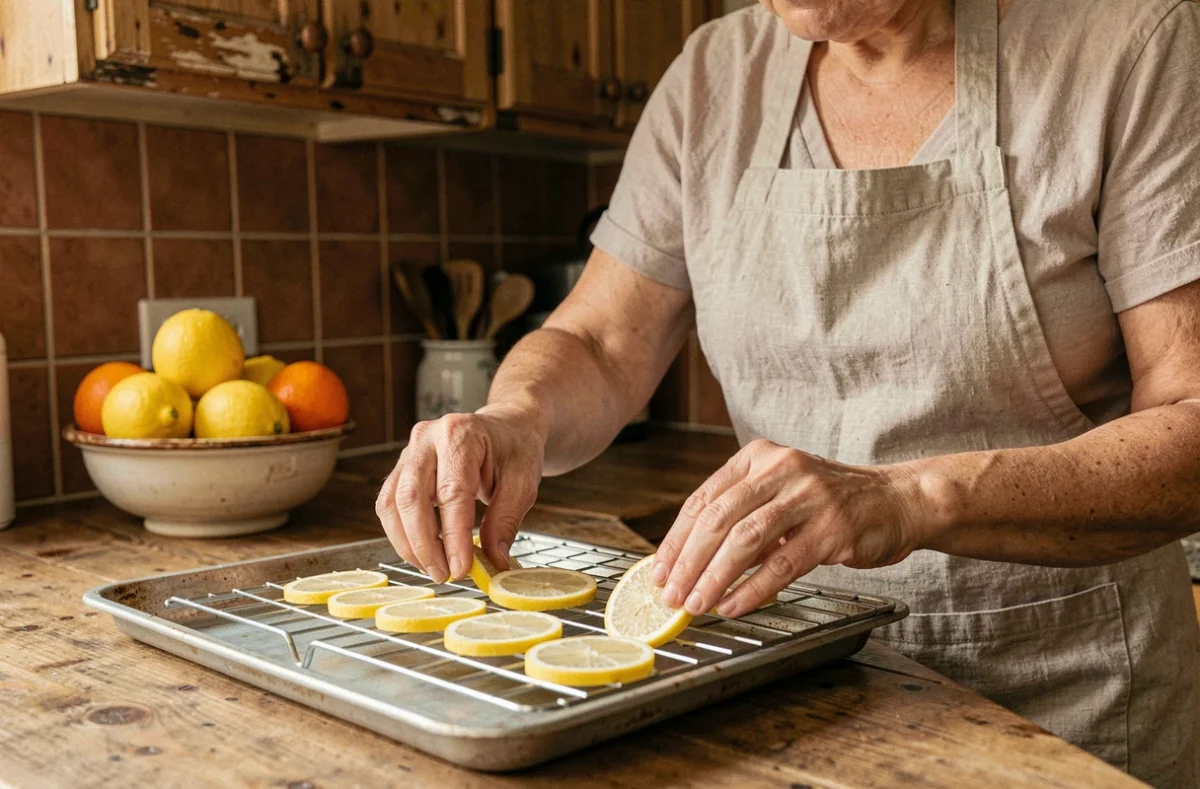
An organic lemon forgotten in the fruit bowl often ends up in the trash. Sliced and dried, it transforms into a condiment, cocktail garnish, or decoration that lasts for several months. Drying citrus fruits at home requires neither expensive equipment nor special skills, but a few precautions make the difference between crispy slices and soft pieces that mold after two weeks.
Hygiene before drying: the point that most tutorials overlook
It is often thought that the heat from the oven or dehydrator is enough to sanitize the slices. In reality, drying does not kill microorganisms: it removes water and limits their growth. If the surface of the lemon or orange has pesticide residues, microscopic mold, or bacteria from handling, they will remain on the dried slice.
The steps to follow before getting out the mandoline:
- Wash each citrus fruit under running water, scrubbing the skin with a vegetable brush, even for organic fruits. Then wipe with a clean cloth.
- Disinfect the cutting board, knife, and work surface. A simple wipe with white vinegar followed by a rinse is sufficient.
- Work with clean, dry hands to avoid transferring moisture to the freshly cut slices.
This rigor is even more necessary when the dried citrus is intended for cooking or beverages. For Christmas decoration, the health risk is lower, but mold remains the enemy of preservation.
When you want to prepare dried lemons and other citrus fruits under the best conditions, this prior cleaning directly affects the shelf life of the finished product.
Cutting and thickness of citrus slices: the detail that changes everything
A slice that is too thick remains moist in the center. A slice that is too thin falls apart during handling. Aim for a consistent thickness of a few millimeters, preferably using a mandoline rather than a knife.
Consistency matters more than fineness. Two slices of different thicknesses on the same tray dry at different speeds. One will be charred while the other is still pliable. To avoid this pitfall, group the slices by thickness if the batch is heterogeneous.
Lemons, oranges, grapefruits: adapting the cut to the fruit
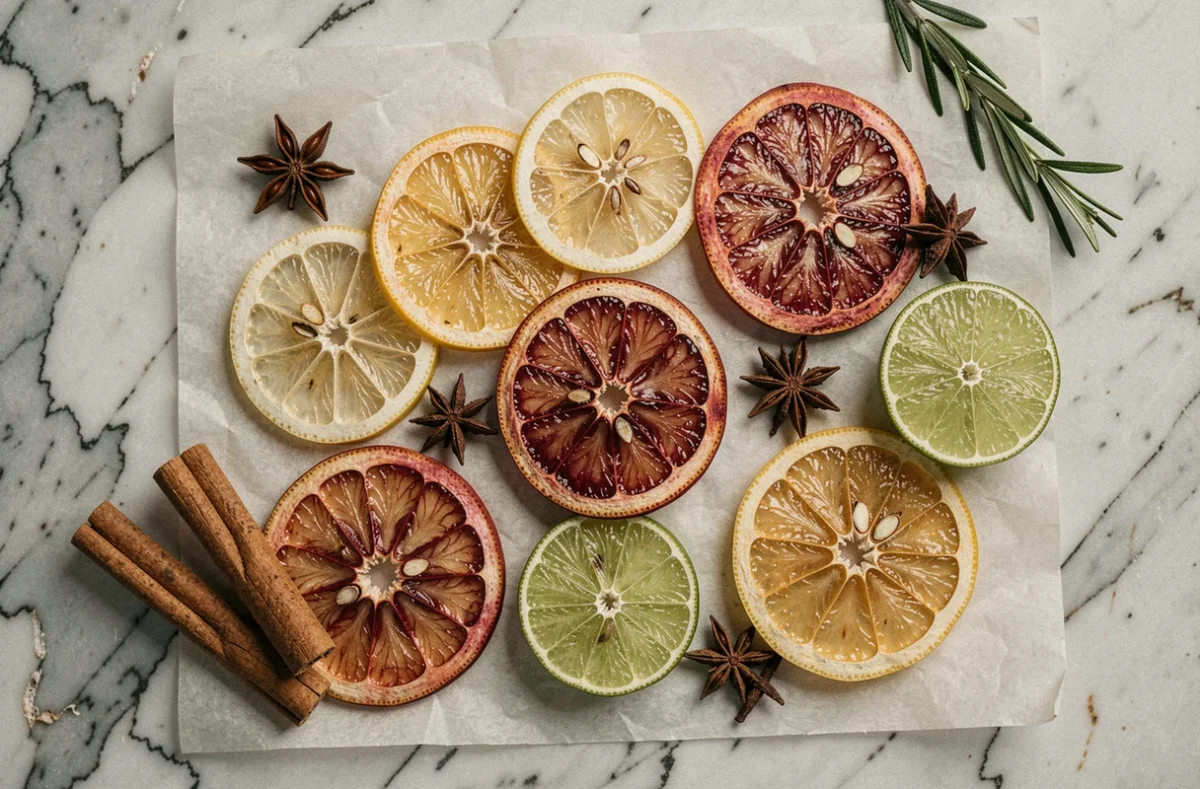
Yellow lemons and limes, smaller and less juicy, dry faster than oranges. They can be sliced slightly thicker. Navel oranges, which are very fleshy, require thin slices and a longer drying time. Grapefruit, full of water, takes the longest to dehydrate: it is reserved for decorative slices or cut into thin wedges.
Removing the seeds before drying makes it easier to use in cooking. For cocktails, keep the skin intact: it adds bitterness and holds its shape better once dried.
Oven drying versus dehydrator: cooking times and results
The household oven works very well for drying citrus fruits. Set it to a low temperature, with the door slightly open to allow moisture to escape. The slices are arranged in a single layer on a rack (not on a tray, as the bottom will remain moist) with parchment paper underneath to catch the juice.
Turning the slices halfway through cooking ensures even drying. Check regularly: the time varies depending on the oven, the thickness of the slices, and the ambient humidity. Feedback varies on this point; some achieve perfect slices in a few hours, while others need much longer with the same oven.
The dehydrator: slower, more consistent
A food dehydrator maintains a constant temperature and continuous airflow. The result is more predictable than in the oven. The slices retain their color better, especially lime slices, which tend to brown quickly in the oven.
The investment is justified if you regularly dry fruits, herbs, or vegetables. For occasional use (Christmas decoration, a few slices for cocktails), the oven is more than sufficient.

The conditioning test: checking that the drying is complete
This is the most reliable technique to ensure that the citrus fruits are ready to be stored, and it is rarely mentioned in common recipes. Once the slices have cooled to room temperature, place them in a closed glass jar.
Shake the jar every day for about a week. If condensation appears on the inner walls, the slices still contain too much residual moisture. They should be returned to the oven or dehydrator before being stored permanently.
This conditioning test protects against mold that can sometimes develop weeks after drying when one thinks the job is done. A citrus fruit that feels dry to the touch may still contain enough water to cause fungal growth in a closed jar.
Long-term storage of homemade dried citrus fruits
Once the conditioning test is passed, transfer the slices to an airtight container, away from light and moisture. A glass jar with a seal, a resealable bag emptied of air, or a metal box are suitable.
- Completely dehydrated slices can be stored for several months in a dry cupboard at room temperature.
- Candied or semi-dried citrus fruits (still soft in the center) should be kept in the refrigerator and consumed quickly, as their residual moisture promotes bacterial growth.
- For decorative use, a light spray of food varnish can be applied, or simply leave the slices exposed to air, accepting that they will lose their color over the months.
Decoration or cooking: two storage logics
In cooking, perfectly dry and brittle slices are sought, which rehydrate in a stew, herbal tea, or cocktail. For Christmas recipes or garlands, the residual flexibility gives a more elegant appearance but at the cost of shorter preservation.
Labeling each jar with the drying date allows for tracking rotation. Homemade dried citrus fruits do not have an official expiration date: it is the absence of condensation and mold that confirms their good condition.